Choosing the right infrastructure for client communication is a defining moment for any agency. A professional Kundenportal Plattform Vergleich reveals that the friction between "just sending emails" and "centralizing operations" is where most agencies either scale or stagnate.
Comparing PM Portals for Small vs. Large Agencies: at a glance
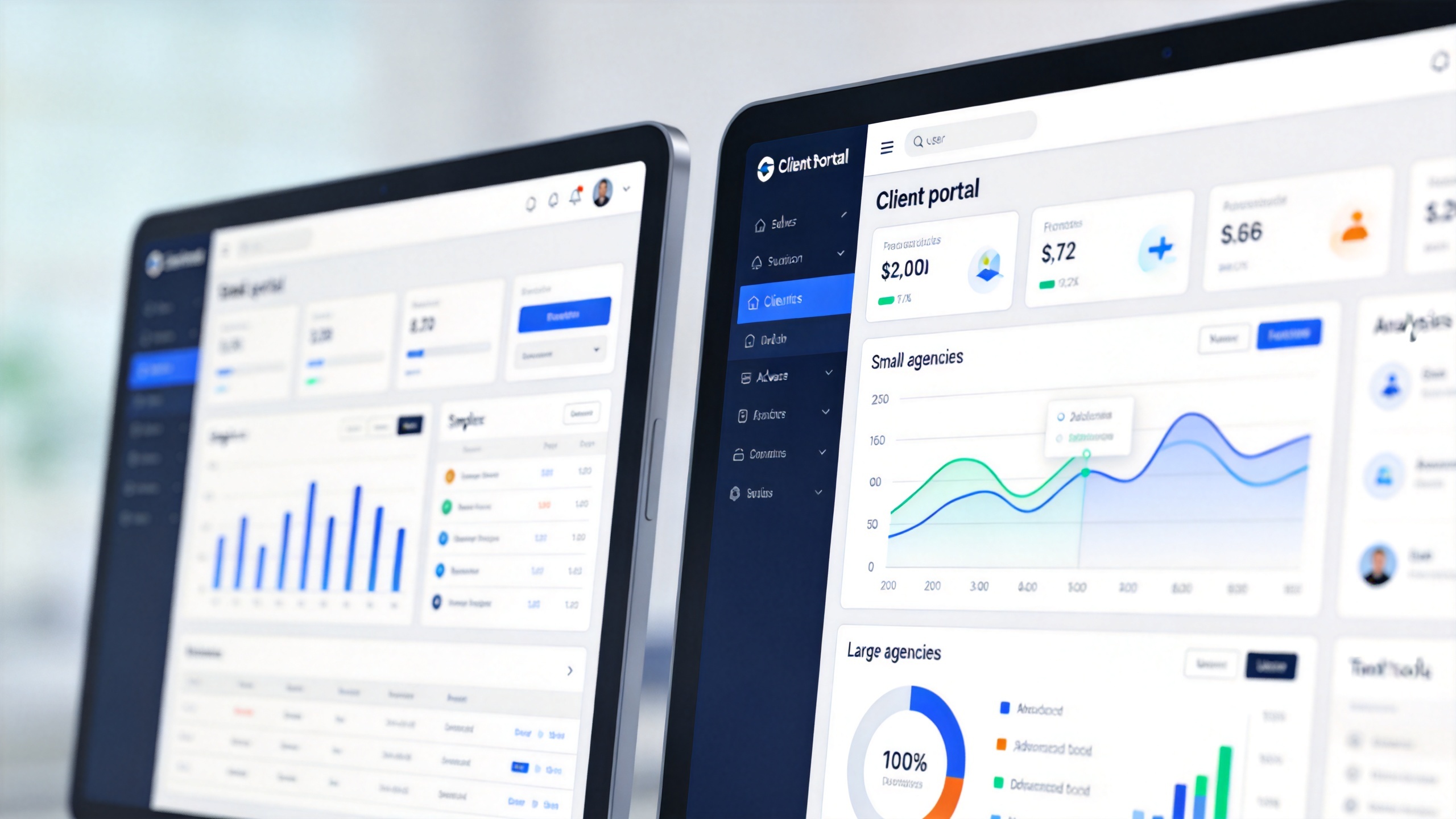
When evaluating software, the gap between a boutique firm and a large agency is often defined by the complexity of the workflow. Small agencies prioritize speed, ease of setup, and cost-effectiveness. They need a "plug-and-play" environment where a client can log in, approve a creative asset, and pay an invoice without needing a 30-minute training session.
Large agencies, conversely, prioritize integration, permission management, and auditability. They are managing hundreds of concurrent projects, often involving multiple internal departments and external stakeholders. For them, a portal isn't just a communication hub; it is an extension of their CRM and ERP systems.
- Small Agency Needs: Low barrier to entry, intuitive UI, integrated billing, and minimal configuration.
- Large Agency Needs: Role-based access control (RBAC), API access for custom integrations, white-labeling capabilities, and robust reporting.
- Common Ground: Both sizes require a secure environment that prevents "information leakage" (sending files to the wrong client) and ensures a professional brand image.
The Evolution of Client-Facing Transparency
The shift toward client portals is driven by the demand for "on-demand" transparency. Clients no longer want to wait for a weekly status report; they want to see the progress of their project in real-time. This shift has changed the role of the account manager from a "messenger" to a "strategic consultant."
Platforms like [Zendo] offer a unique approach by combining service requests with a portal interface, making it ideal for agencies that operate on a productized service model. By centralizing requests, quotes, and delivery, the agency reduces the cognitive load on both the client and the team.
- Self-Service Capabilities: Allowing clients to track their own project status.
- Asset Centralization: Keeping the latest versions of deliverables in a single, secure location.
- Feedback Loops: Enabling direct, context-aware comments on specific project tasks.
Head-to-Head: Feature Parity vs. Specialization
When performing a Kundenportal Plattform Vergleich, you will notice that some tools are "generalists" while others are "specialists." A generalist tool manages the entire project lifecycle, while a specialist tool might focus purely on the client-facing deliverables.
[SuperOkay] excels in the "client-facing" space by providing a clean, professional dashboard for sharing assets and project updates without the overhead of a full-blown project management suite. This is often more effective for small agencies that already have a PM tool (like Trello or Asana) but lack a professional way to present work to clients.
- Generalist Tools: Offer time tracking, internal task management, and resource scheduling.
- Specialist Tools: Focus on the "last mile" of the client experience—sharing links, gathering feedback, and approvals.
- Integration Strategy: Determine if you want a "single source of truth" or a "best-of-breed" stack.
Pricing Models and Scalability
Pricing in the SaaS world is rarely "one size fits all." For small agencies, per-seat pricing is usually the most sustainable. However, as you grow, you may find that per-seat pricing becomes a liability. Large agencies should look for platforms that offer enterprise tiers or unlimited client seats to avoid "license bloat."
Platforms like [awork] offer a balanced approach to project management that includes portal-like features, making it a strong contender for agencies that want to keep internal and external work in one ecosystem. When evaluating pricing, consider the "hidden costs": training time, migration costs, and the time spent maintaining the portal.
- Tiered Pricing: Based on the number of active projects or users.
- Flat-Fee Models: Often found in specialized portal tools, favoring high-volume client interaction.
- Hidden Costs: Look for limits on storage, number of clients, or API calls.
Who Should Pick Which: The Small Agency Perspective
Small agencies are often constrained by time. The "perfect" portal for a small agency is one that can be set up in an afternoon. If it takes a week to configure, it’s the wrong tool. Focus on tools that offer white-labeling so you can keep the focus on your brand, not the software provider’s brand.
For agencies heavily focused on social media management, [Vista Social] provides a streamlined way to involve clients in the approval process, effectively acting as a portal for content strategy. If your agency does a mix of social, SEO, and paid media, [AgencyAnalytics] is the industry standard for providing high-level performance dashboards that clients can access 24/7.
- Focus on Speed: Choose tools with pre-built templates.
- Prioritize Client UX: If the client finds it confusing, they will revert to email.
- Integrated Billing: For small teams, having invoices inside the portal is a massive time-saver. Consider [Harvest] for robust time tracking and billing, which can be linked to your portal experience.
Who Should Pick Which: The Large Agency Perspective
Large agencies need to account for complex hierarchies. You might have a client with 20 different stakeholders, each needing different levels of access. You need a platform that supports "Client Teams" and granular permissions.
Tools like [Troi] and [Exxas] are built with the structural depth required by larger agencies. They handle the heavy lifting of resource management and project profitability, which are critical when you have dozens of employees working across multiple client accounts.
- Role-Based Access: Essential for preventing unauthorized access to sensitive financial or strategic data.
- API Capabilities: Necessary for connecting the portal to your existing CRM (like Salesforce or HubSpot).
- Audit Trails: Large agencies need to know exactly who approved a deliverable and when.
The Role of Communication and Support
A portal is not just a file repository; it is a communication channel. If your portal doesn't support easy messaging, your clients will still email you. High-performing portals integrate chat or ticket-based communication directly into the project view.
[LiveAgent] offers a robust support infrastructure that can be adapted for agency-client communication, ensuring that no request falls through the cracks. By moving communication into the portal, you create a searchable history of decisions, which is invaluable when disputes arise or when new team members join a project.
- Contextual Communication: Commenting on the specific task or file.
- Automated Notifications: Keeping clients in the loop without manual status updates.
- Searchability: Finding that one decision made six months ago.
Managing Deliverables and Approvals
The "approval bottleneck" is the primary cause of project delays in agencies. A good portal platform streamlines this by providing a clear "Approve/Reject" button. This eliminates the "I never saw that email" excuse.
[Corcava] provides a specialized environment that helps in managing the client relationship effectively. When the approval process is formalized, the agency gains a legal layer of protection, as every approval is timestamped and linked to the version of the file being approved.
- Version Control: Ensure clients are looking at the latest draft, not a file from three weeks ago.
- Approval Workflows: Multi-stage approvals for complex projects.
- Audit Logs: Essential for compliance and accountability.
Integrating Sales and Onboarding
The client journey doesn't start when the project begins; it starts with the proposal. Some portals allow you to transition seamlessly from a signed proposal to an active project workspace.
[LeadTable] helps bridge the gap between lead generation and client management. By integrating the initial data collection with the project setup, you reduce the "onboarding friction" that often makes agencies look disorganized during the first week of a new contract.
- Seamless Onboarding: Turning a signed contract into a project automatically.
- Data Collection: Using forms to gather assets during the onboarding phase.
- Relationship Continuity: Ensuring the sales team's promises are reflected in the project portal.
Security and Data Privacy Considerations
When you host client data, you become a custodian of their information. Security cannot be an afterthought. Ensure the platform you choose supports SSO (Single Sign-On), MFA (Multi-Factor Authentication), and GDPR-compliant data storage.
Large agencies, in particular, should perform a security audit on any SaaS platform they adopt. Ask for their SOC2 report or their data processing agreement (DPA). For smaller agencies, choosing a reputable, established SaaS provider is often the safest route, as they invest more in security than a small firm could on its own.
- Encryption: Ensure data is encrypted both in transit and at rest.
- Backups: Does the provider offer automated, redundant backups?
- Compliance: Verify compliance with regional laws like GDPR, CCPA, or HIPAA if applicable.
FAQ: Frequently Asked Questions
Does a client portal replace email entirely?
In most cases, no. You will still use email for initial introductions and urgent, non-project-specific communication. However, a portal should replace email for all project-related tasks, file sharing, and approval processes to keep communication organized.
How do I get clients to actually use the portal?
The key is "low friction." If the portal requires a complex login process, they won't use it. Use SSO options, provide a clear, one-page "how-to" guide, and ensure the portal adds value to them (e.g., by giving them faster access to their files than email search).
Is it worth the cost for a small agency?
Calculate the time your team spends searching for files, resending lost emails, and chasing approvals. If a portal saves your team even two hours a month, it often pays for itself. Use a Kundenportal Plattform Vergleich to find tools that fit your budget.
Can I white-label these platforms?
Many of the platforms mentioned, such as [SuperOkay] and [Zendo], offer white-labeling. This allows you to host the portal on your own domain (e.g., portal.youragency.com) and use your own branding, which is critical for maintaining a professional image.
What if I need to switch platforms later?
Data migration is the biggest challenge in the SaaS world. Before committing, check if the platform allows for bulk export of files and project data. A platform that traps your data is a long-term risk.
Verdict
The search for the right Kundenportal Plattform Vergleich is ultimately about finding the balance between your agency's operational maturity and your client's technical comfort. For a small agency, the focus should be on tools like [SuperOkay] or [Zendo] that prioritize a frictionless, branded experience. For larger agencies, the focus shifts to the robust, integrated ecosystems provided by [Troi] or [Exxas].
The most successful agencies are those that recognize that a portal is not just a piece of software; it is a commitment to transparency and professionalism. By moving your client interactions into a structured, dedicated environment, you stop being a service provider and start being a strategic partner. Choose the tool that fits your current needs, but ensure it has the flexibility to grow as your agency scales.